
Breaking the Monolith – A Deep Dive into commercetools
Welcome to the very first issue of our commercetools Newsletter! 🎉
If you are reading this, your team is likely navigating the massive shift from traditional, all-in-one e-commerce platforms to modern, flexible architectures. It is a fundamental change in how we build and scale online businesses. In this premier issue, we are unpacking exactly what makes commercetools the engine of modern commerce, why monolithic systems are fading, and how this platform unlocks unprecedented growth.
🏛️ The Monolith Problem:Why Traditional E-commerce is Slowing You Down:
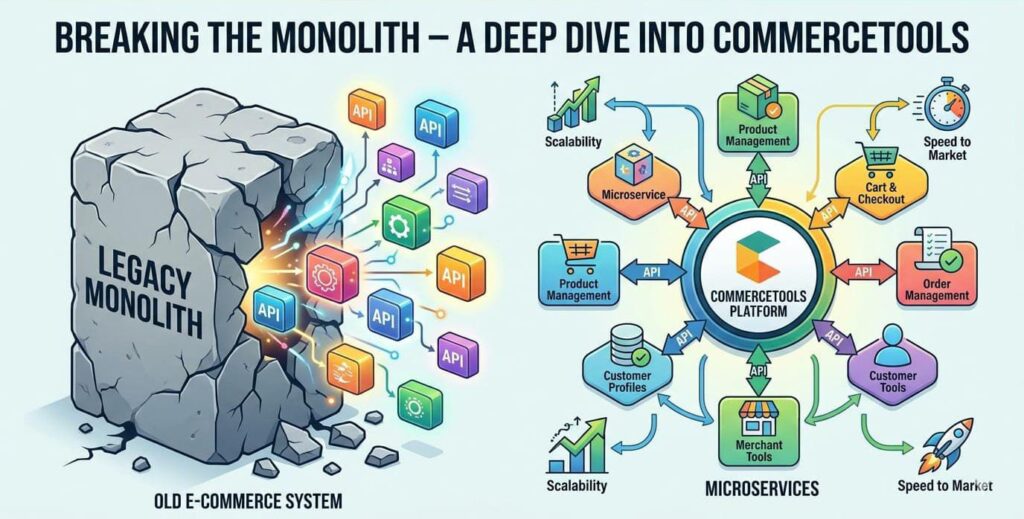
For the past decade, the standard way to build an online store was using a “monolith.” In these legacy systems, the frontend (what the customer sees), the backend (cart, checkout, business logic), and the database are all tightly bundled together.
While this was great for getting started quickly, it created massive bottlenecks as businesses grew:
- The Domino Effect: Changing a simple design element on the frontend could accidentally break the checkout logic in the backend.
- Slow Innovation: Deploying new features takes weeks or months because the entire system has to be tested and released at once.
- Poor Omnichannel Support: Monoliths were built for web browsers. Trying to connect them seamlessly to mobile apps, smartwatches, or in-store POS systems feels like forcing a square peg into a round hole.
🏗️ Enter commercetools: The MACH Pioneer
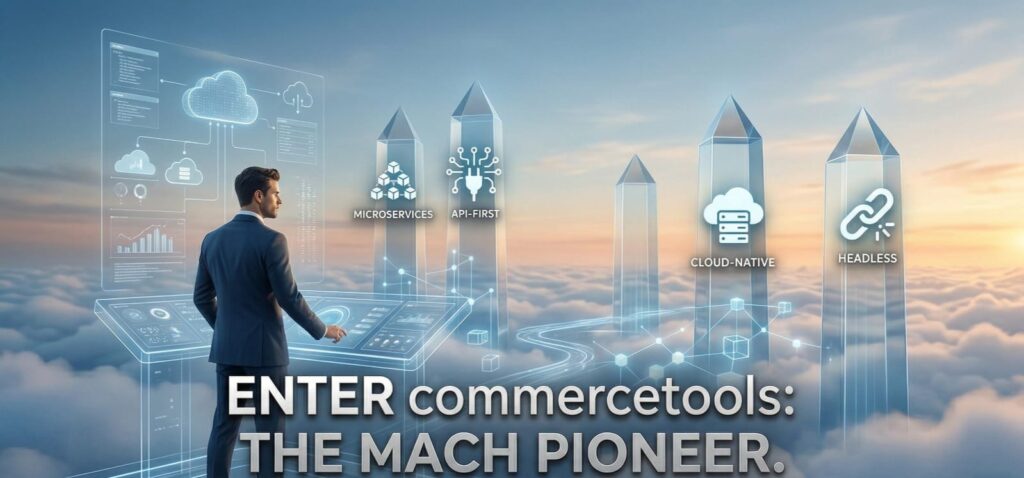
commercetools didn’t just iterate on the old way of doing things; it completely reinvented the e-commerce backend. It is the leading platform built entirely on MACH principles, which is now the gold standard for enterprise commerce:
- M - Microservices: Instead of one massive application, commercetools breaks commerce down into independent, bite-sized services (e.g., Inventory, Cart, Pricing, Customers). If you need to update the pricing engine, it won't impact the shopping cart.
- A - API-first: There is no default, restrictive frontend template. Every single piece of data and functionality is exposed via robust APIs. This means your frontend team has absolute freedom to build the UI/UX however they want.
- C - Cloud-native: commercetools operates purely as a SaaS (Software as a Service) platform. Say goodbye to server maintenance, manual database scaling, and painful version upgrades. It scales automatically to handle massive traffic spikes (like Black Friday) without breaking a sweat.
- H - Headless: The presentation layer is completely decoupled from the commerce logic.
⚙️Core Capabilities: What Makes commercetools Stand Out?
Beyond just the architecture, commercetools provides a suite of tools designed for both developers and business users:
1. The Flexible Product Data Model
Unlike legacy systems that force your products into rigid database tables, commercetools allows you to define complex, highly customized product types. Whether you are selling simple t-shirts, complex configurable machinery, or digital subscriptions, the data model molds to your business, not the other way around.
2. The Merchant Center
While developers love the APIs, business teams get the Merchant Center—a highly intuitive, web-based interface. Here, marketing, sales, and catalog managers can effortlessly manage product data (PIM), set up complex promotional discounts, track orders, and manage customer data without ever needing to ask a developer for help.
3. Limitless Extensibility
What happens if you need a feature that commercetools doesn’t have out of the box? In the past, you would have to “hack” the core code. With commercetools, you use API Extensions and Subscriptions (Webhooks). You can build your custom logic in your own environment and simply tell commercetools to communicate with it in real-time.
🚀 The Real-World Business Value
Switching to commercetools isn’t just an IT upgrade; it drives measurable business results:
🎯 What’s Next?
- True Omnichannel Experiences: Because the core is headless, you can use the exact same commercetools backend to power your website, your mobile app, social commerce, and even IoT devices.
- Drastically Faster Time-to-Market: Frontend designers and backend engineers can work in parallel. You can launch new features, pop-up stores, or entirely new brands in weeks, not months.
- No More "Re-platforming": Because of the microservices approach, you will never need to do a massive "rip and replace" migration again. You can swap out individual components (like your search engine or payment gateway) as your business evolves.
The shift to composable commerce is a journey, and we are here to guide you through it. In our next issue, we will dive deep into Navigating the commercetools Merchant Center, exploring how business teams can maximize their daily operations.