
Multi-Brand Commerce Architecture
Multi-Brand Commerce Architecture: Building and Managing Multiple Storefronts with Composable Commerce
Introduction
Businesses operating multiple brands often need to deliver different shopping experiences while maintaining efficient commerce operations. Each brand may have its own visual identity, product assortment, pricing strategy, promotional campaigns, and customer expectations. Managing these requirements through completely separate systems can increase development effort, maintenance costs, and operational complexity. A well-designed multi-brand commerce architecture helps businesses balance brand independence with shared operational capabilities.
Composable commerce provides a flexible approach to building this architecture by allowing businesses to combine commerce capabilities according to their specific requirements. Instead of maintaining an entirely separate technology stack for every brand, organizations can reuse selected services while preserving brand-specific functionality. This approach supports consistent operations, faster expansion, and more efficient resource utilization. However, the architecture must be designed carefully to ensure that shared services do not restrict the individual needs of each brand.
What Is Multi-Brand Commerce Architecture?
Multi-brand commerce architecture is a technical and operational model that enables an organization to manage multiple brands and their digital storefronts within a coordinated commerce ecosystem. Each storefront can maintain its own design, content, product assortment, pricing rules, and customer experience while using selected shared backend capabilities. The degree of sharing depends on the organization’s business structure, technical requirements, and operational strategy.
In a composable commerce environment, these capabilities may include product information management, pricing, promotions, inventory, order management, payments, and customer identity services. Some brands may use the same underlying service with separate configurations, while others may require dedicated instances or independent services. This flexibility allows organizations to establish a suitable balance between centralized management and brand-level autonomy without requiring every brand to follow an identical operating model.
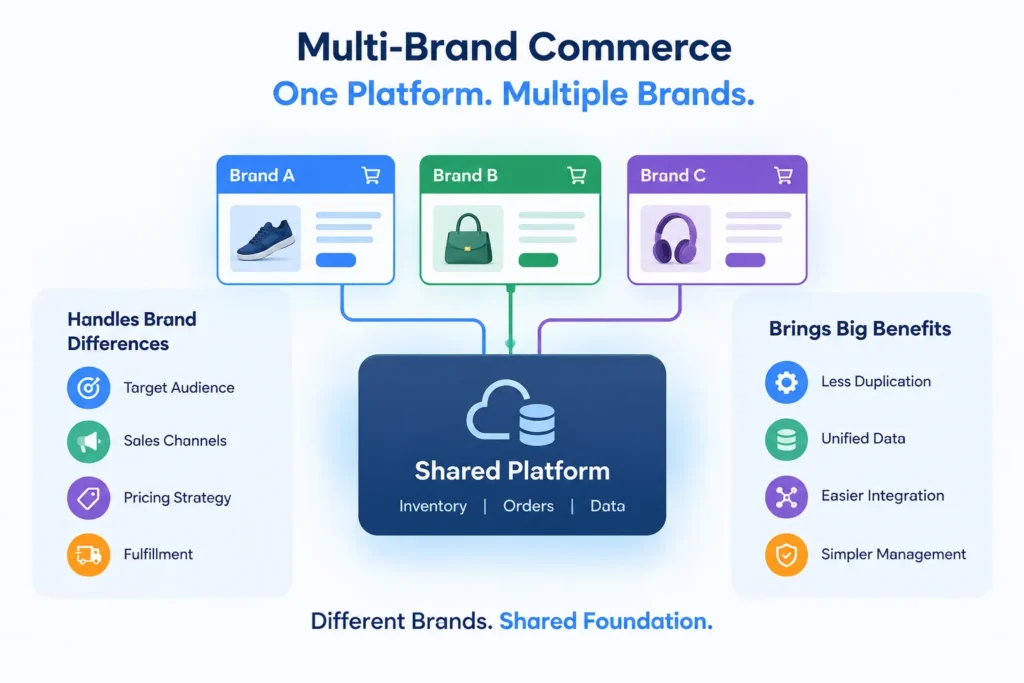
As businesses expand into new markets, acquire additional brands, or introduce new product lines, their commerce requirements often become more complex. Different brands may target different customer segments, operate through different sales channels, or follow different pricing and fulfillment strategies. Using completely independent commerce platforms for every brand can result in duplicated functionality, fragmented data, and additional integration work. A coordinated architecture helps businesses manage these differences more systematically.
A multi-brand approach also allows organizations to standardize selected operational processes without eliminating brand-specific experiences. For example, a company may centralize inventory visibility and order processing while allowing each brand to control its storefront design and marketing campaigns. This arrangement can simplify administration and reduce unnecessary duplication. The main objective is not to make every brand identical, but to provide a shared technical foundation that supports their individual business needs.
How Composable Commerce Supports Multiple Storefronts
Composable commerce enables organizations to assemble their commerce environment from capabilities that can be selected, configured, and managed according to business requirements. In a multi-brand implementation, several storefronts may connect to shared backend services through APIs or other supported integration mechanisms. Each storefront can present a different customer experience while using common capabilities for functions such as cart management, inventory access, or order processing.
For example, a retail organization managing three brands may maintain separate storefronts and product assortments while using a common order management system. The system can process orders from different brands according to their respective fulfillment rules and business policies. Shared services must support the necessary brand context so that pricing, promotions, inventory, and order information are handled correctly. This design allows the organization to reuse suitable capabilities while retaining the flexibility required by each brand.
Key Components of a Multi-Brand Commerce Architecture
A multi-brand commerce environment consists of several interconnected components that support customer-facing experiences and backend operations. The exact combination depends on whether the organization operates direct-to-consumer storefronts, B2B portals, regional websites, or a mixture of commerce channels. Each component should have a clearly defined responsibility and an appropriate method for handling brand-specific configurations and data.
The following components commonly form part of a multi-brand commerce implementation:
Storefronts
Provide brand-specific interfaces, navigation, product presentation, and shopping experiences. Storefronts can be independently designed while reusing shared frontend components where appropriate.
Product Information Management (PIM)
Maintains product attributes, descriptions, images, and related information. Product data can be reused across brands, with brand-specific content or assortment rules applied where needed.
Commerce Services
Support capabilities such as carts, checkout, promotions, and order creation. These services may be shared or separated depending on functional requirements.
Pricing and Promotions
Manage product prices, discounts, eligibility rules, and campaigns. Brand-specific rules must be applied correctly even when a common pricing or promotion service is used.
Inventory and Order Management Systems (OMS)
Support stock visibility, order routing, fulfillment, and order lifecycle management across supported channels and brands.
Identity and Access Management
Controls authentication, permissions, and administrative access. It helps ensure that staff and customers access only the appropriate brand experiences and resources.
Shared vs. Brand-Specific Capabilities
One of the most important decisions in multi-brand commerce architecture is determining which capabilities should be shared and which should remain brand-specific. Sharing suitable services can reduce duplication and simplify administration, particularly when several brands follow similar business processes. However, excessive centralization can create unnecessary dependencies when brands have substantially different requirements. Organizations should evaluate each capability based on business rules, data ownership, scalability, and operational needs.
A shared service can still support different behavior through configuration, tenant or brand context, and clearly defined access policies. Conversely, a capability may require separate instances when brands have different compliance requirements, release schedules, or operational boundaries. The correct design is therefore not always a single shared platform or a completely separate stack. It is a deliberate combination of reuse and separation.
Capability | Shared approach | Brand-specific approach |
Storefront | Shared design system and reusable components | Independent layouts and branding |
Product catalog | Common product records where appropriate | Brand-specific assortments and content |
Pricing | Shared pricing service | Different price lists and pricing rules |
Promotions | Common promotion engine | Separate campaigns and eligibility conditions |
Inventory | Shared inventory visibility | Brand-specific allocation or fulfillment rules |
Customer identity | Common identity provider | Separate account policies or data boundaries |
Order management | Shared order processing platform | Brand-specific workflows and routing rules |
The table represents common design options rather than mandatory architectural rules. For example, sharing a product information system does not mean that every brand must display the same products or descriptions. Similarly, a common identity provider does not require all brands to share customer accounts or authorization policies. Each sharing decision should reflect the actual business requirements and the capabilities of the selected systems.
Managing Product Catalogs, Pricing, and Promotions Across Brands
Product catalog management becomes more complex when multiple brands sell overlapping products or maintain different assortments. Organizations must determine which product attributes can be shared and which descriptions, images, specifications, or merchandising details need to be customized. A common product information source can reduce duplicated data management, provided the architecture supports brand-specific content and publication rules. Product visibility should also be controlled according to the assortment and market requirements of each storefront.
Pricing and promotions require similar care because different brands may operate under different commercial strategies. A shared pricing service may support multiple price lists, currencies, customer segments, and market-specific rules, depending on its capabilities. Promotional eligibility should be evaluated in the correct brand and channel context to prevent discounts from being applied incorrectly. These requirements should be reflected in business rules, configuration, and automated tests rather than relying solely on storefront-level restrictions.
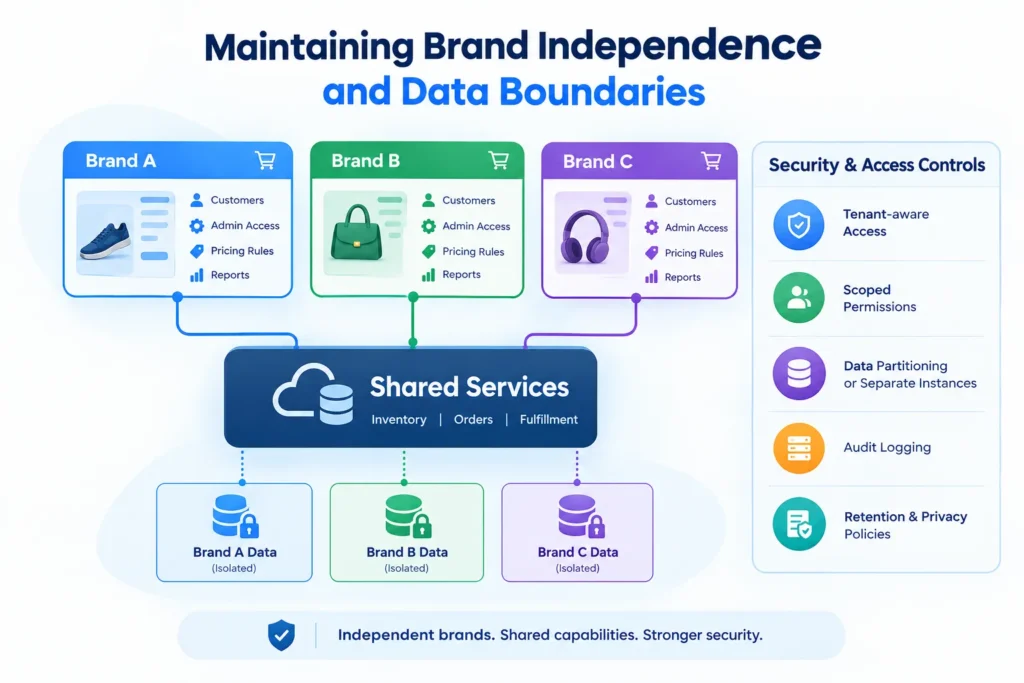
Although shared services can improve efficiency, each brand may require independent control over customer information, administrative access, commercial rules, and business reporting. The architecture should define which data can be shared, which data must remain separate, and which roles are permitted to access each resource. These boundaries may be implemented through tenant-aware access controls, scoped permissions, data partitioning, or separate service instances, depending on the system and risk requirements.
Brand separation should be enforced by backend services and data-access policies rather than by hiding information in the user interface alone. For example, an administrator responsible for one brand should not automatically gain access to another brand’s customer records or order information. Organizations should also consider audit logging, retention policies, and applicable privacy obligations. Clear data ownership and access rules help maintain security while allowing approved shared capabilities to operate across the ecosystem.
Common Challenges in Multi-Brand Commerce
Managing multiple storefronts introduces challenges that may not be apparent when operating a single brand. Shared services can become critical dependencies, and changes to common functionality may affect several storefronts at once. Inconsistent configurations can also lead to differences in pricing, product availability, checkout behavior, or order processing. Without clear ownership and testing procedures, these issues can become more difficult to diagnose as the number of brands increases.
Key Risks and Design Considerations
Organizations should address these risks during architecture design rather than waiting until the ecosystem becomes difficult to maintain. Important considerations include:
Configuration Consistency
Establish standards for managing brand-specific settings without removing necessary flexibility.
Release Coordination
Evaluate the impact of changes to shared services before deploying them across multiple brands.
Data Quality
Define ownership and validation rules for product, pricing, inventory, and customer information.
Operational Visibility
Track service health and business transactions with enough context to identify the affected brand.
Access Control
Verify that users, administrators, and services can access only the resources permitted by their roles.
Scalability
Assess whether shared services can handle combined demand and whether individual brands need different scaling arrangements.
Architecture takeaway: Address configuration, deployment, data governance, observability, security, and scalability early to keep a multi-brand commerce ecosystem reliable and maintainable.
Best Practices for Building a Scalable Multi-Brand Architecture
A successful implementation begins with understanding the similarities and differences between the brands that the organization operates. Businesses should document requirements for storefront experiences, product assortments, pricing, customer identity, order processing, and fulfillment before deciding which capabilities to share. This assessment helps avoid unnecessary duplication while preventing the creation of shared services that cannot accommodate legitimate brand-specific requirements.
Organizations should also establish clear ownership for each service and define how brand-specific configuration is managed throughout development and production. Automated tests should validate shared functionality as well as important brand-specific customer journeys, including product discovery, promotions, checkout, and order placement. As new brands are introduced, teams should evaluate the impact on existing services, operational processes, and capacity requirements before extending the ecosystem.
When Should Businesses Use a Multi-Brand Commerce Architecture?
A multi-brand commerce architecture is particularly useful for organizations that operate several brands with overlapping technical requirements but different customer experiences. Retail groups, consumer goods companies, and enterprises managing multiple regional or product-specific storefronts may benefit from sharing selected commerce capabilities. The approach can reduce duplicated functionality and make it easier to introduce additional storefronts when the underlying services and operational processes support that growth.
However, a shared architecture is not automatically the best option for every organization. Brands with substantially different regulatory obligations, business models, security requirements, or release cycles may need greater separation between systems. Businesses should compare the operational benefits of reuse with the costs of coordination, integration, and shared dependencies. The most appropriate design is the one that supports the organization’s business goals while maintaining manageable complexity and clear operational boundaries.
Conclusion
Multi-brand commerce architecture enables organizations to manage distinct storefronts through a coordinated commerce environment while preserving the flexibility each brand requires. Composable commerce supports this model by allowing businesses to combine shared services, brand-specific configurations, and independently managed capabilities according to their needs. The architecture can support more consistent operations without requiring every brand to use identical catalogs, pricing strategies, or customer experiences.
Achieving these benefits requires deliberate decisions about service ownership, data boundaries, configuration, testing, and operational responsibility. Businesses should share capabilities where reuse provides clear value and maintain separation where independence is important. With a well-defined architecture and appropriate governance, organizations can expand their multi-brand commerce operations while keeping their digital experiences differentiated, secure, and maintainable.