
Subscription Lifecycle Management in Composable Commerce:
Streamlining Subscription Journeys Through Scalable, Flexible, and Customer-Centric Commerce Experiences
Introduction
Subscription lifecycle management is an important capability for businesses offering recurring products and services. It manages the complete subscription journey, from customer enrollment and activation to renewals, plan modifications, and cancellations. In a composable commerce environment, subscription management can operate as an independent business capability connected to other commerce services. This approach helps businesses build flexible subscription experiences while maintaining control over billing, customer accounts, and recurring transactions.
As subscription-based business models continue to grow, businesses need systems that can manage recurring payments, flexible pricing, and changing customer requirements. Traditional approaches may limit flexibility when subscription functionality is tightly connected to other commerce operations. Composable commerce addresses this challenge by allowing businesses to integrate specialized subscription, billing, and payment services based on their requirements.
What Is Subscription Lifecycle Management in Composable Commerce?
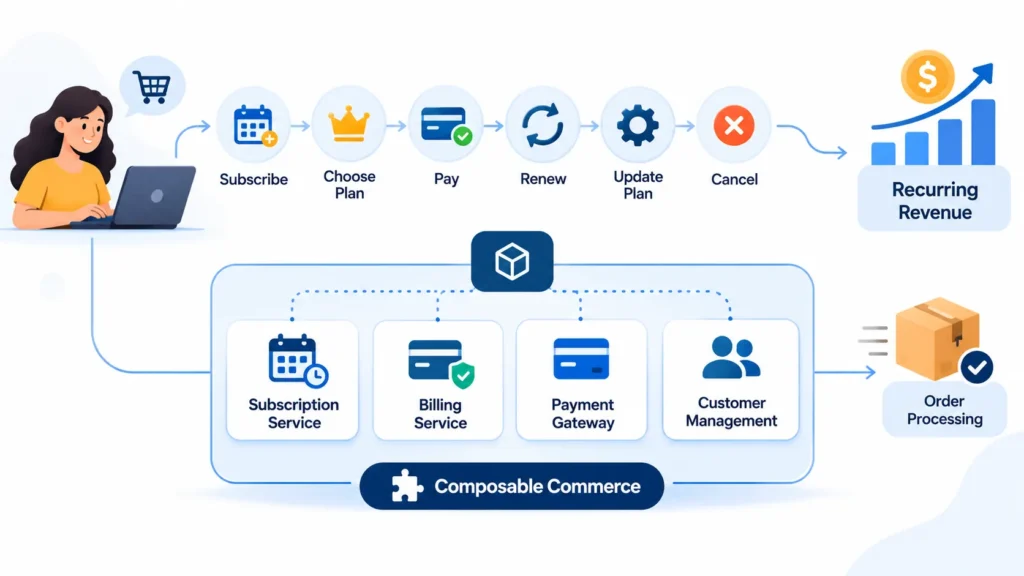
Subscription lifecycle management refers to managing recurring customer relationships through a structured set of processes and services. It covers subscription creation, plan selection, billing schedules, renewals, payment management, plan modifications, and cancellations. Each stage requires coordination between different business functions to ensure a consistent subscription experience. Effective lifecycle management also helps businesses maintain accurate subscription records and recurring revenue operations.
In composable commerce, subscription capabilities can be delivered through specialized services instead of relying on a single commerce platform. APIs connect subscription management with payment gateways, customer management, product catalogs, and order processing systems. This allows businesses to introduce new subscription models or modify existing services without changing their entire commerce environment. Each integrated service maintains its own responsibilities while contributing to the overall subscription experience.
For example, a business can use a dedicated subscription management service to manage recurring plans and subscription status. A separate billing service can calculate recurring charges, while a payment provider handles transaction processing. These services communicate through defined APIs and integration workflows. This separation makes subscription operations easier to adapt as business requirements evolve.
Key Stages of the Subscription Lifecycle
A subscription passes through several stages during its lifecycle, starting with customer enrollment and continuing through renewals or cancellation. Each stage involves specific business rules and interactions between subscription, billing, and customer services. Managing these stages properly helps businesses maintain accurate subscription information and avoid interruptions in recurring services. The main stages include:
Subscription Creation
Customers select a subscription plan, product, pricing option, and billing frequency. The system records the subscription agreement and relevant customer information.
Activation
The subscription becomes active after required validations and payment setup are completed. Activation rules depend on the subscription model and business requirements.
Recurring Billing
Charges are calculated according to the configured billing schedule. The payment service processes the corresponding transactions.
Plan Changes
Customers can upgrade, downgrade, pause, or modify subscriptions according to defined business rules. Changes may take effect immediately or during the next billing cycle.
Renewal
Subscriptions continue for another billing period based on their renewal configuration and contractual terms.
Cancellation and Expiration
Subscriptions are cancelled or allowed to expire according to customer requests, contract conditions, or business policies.
How Subscription Lifecycle Management Works in a Composable Architecture
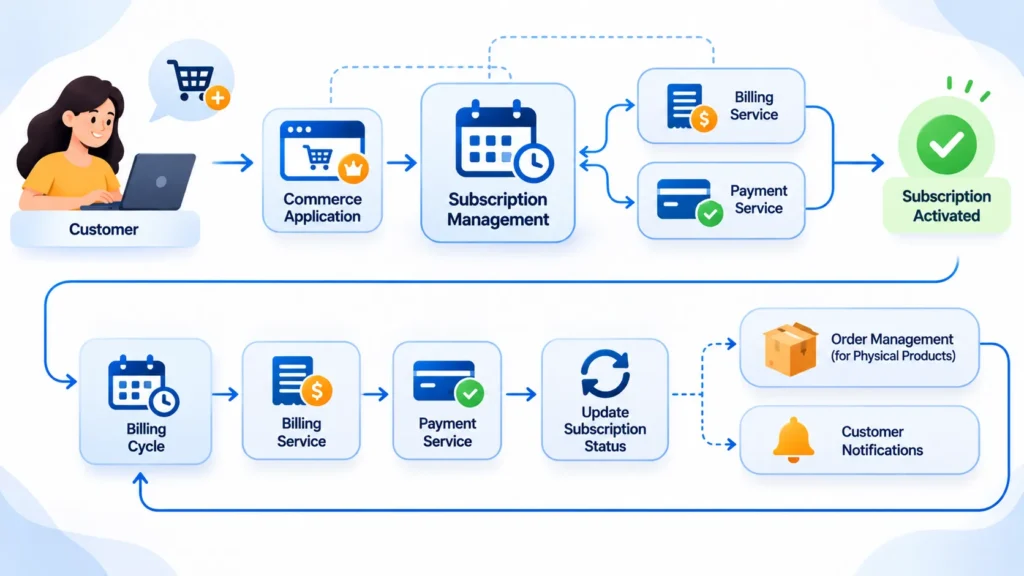
In a composable commerce architecture, subscription management is typically implemented as a dedicated service responsible for subscription records, plan configurations, lifecycle states, and renewal schedules. It communicates with other services through APIs and asynchronous events, depending on the integration requirements. This allows subscription-related operations to function independently while maintaining coordination across the commerce ecosystem. The architecture can also support different subscription models without requiring every service to be redesigned.
For example, when a customer purchases a subscription, the commerce application sends a subscription request to the subscription management service. The service validates the selected plan, creates the subscription record, and coordinates with the billing and payment services. Once the required activation conditions are satisfied, the subscription status is updated. Relevant events can notify other services about the successful subscription creation.
During subsequent billing cycles, the billing service generates charges based on the subscription schedule. The payment service processes the transaction and returns the payment result. Depending on the outcome, the subscription service can update the subscription status, initiate payment recovery workflows, or trigger customer notifications. If the subscription includes physical products, the order management service can coordinate recurring order creation and fulfillment.
Key Components and Their Responsibilities
Component | Responsibility |
Subscription Management | Subscription records, plans, lifecycle states, and renewals |
Billing Service | Billing schedules, invoice generation, and recurring charge calculations |
Payment Service | Payment authorization, transaction processing, and payment status |
Customer Management | Customer accounts, preferences, and subscription information |
Product Catalog | Subscription products, plans, and product pricing |
Order Management | Recurring orders and fulfillment coordination |
Notification Service | Renewal reminders, payment confirmations, and status notifications |
These components work together through defined interfaces while maintaining their individual responsibilities. Not every implementation requires a separate service for each capability, as services can be combined depending on business complexity and platform requirements. The main objective is to establish clear service boundaries and reliable communication between them. This helps prevent unnecessary dependencies across subscription operations.
Essential Integrations for Subscription Commerce
Successful subscription management depends on reliable integration between multiple commerce services. These integrations ensure that subscription changes, billing activities, payment transactions, and customer information remain consistent across the ecosystem. API-based communication supports operations such as creating subscriptions, retrieving billing details, and updating customer preferences. Asynchronous events can coordinate activities such as successful payments, failed renewals, and subscription cancellations.
Payment integration is particularly important because recurring subscriptions require transactions to be processed at defined intervals. The subscription service maintains the subscription schedule, while the billing service calculates the amount due and the payment provider processes the transaction. Customer and order services receive relevant updates when necessary. This separation allows businesses to manage recurring payment operations without tightly coupling them to subscription records.
Important Integrations
Payment Gateway Integration
Supports recurring payment transactions, payment authorization, and failed-payment handling.
Customer Account Integration
Provides access to subscription details, billing history, and account preferences.
Product and Pricing Integration
Connects subscription plans with product information, pricing, and billing intervals.
Order Management Integration
Coordinates recurring orders and fulfillment when subscriptions include physical products.
Notification Integration
Sends renewal reminders, payment confirmations, and subscription status updates.
Tax Service Integration
Calculates applicable taxes for subscription charges based on jurisdiction and transaction requirements.
Best Practices for Subscription Lifecycle Management
Businesses should design subscription services with flexibility, reliability, and accurate billing processes in mind. A well-designed implementation should handle payment failures, subscription changes, and renewal exceptions without creating inconsistent customer records. Each service should have clearly defined responsibilities and validation rules. This helps businesses maintain predictable subscription operations as the number of customers and recurring transactions increases.
Subscription workflows should also define how lifecycle transitions occur and which service is responsible for each operation. For example, a failed payment should not automatically result in immediate subscription cancellation unless the configured business policy requires it. Instead, the system may initiate payment retries, update the subscription status, and notify the customer. Clearly defined workflows help prevent incorrect status changes and billing inconsistencies.
Subscription Best Practices
Key practices for effective subscription management
Maintain Clear Subscription States
Define states such as pending, active, past due, paused, cancelled, and expired. Specify valid transitions between these states.
Automate Recurring Billing
Use reliable billing schedules, invoice generation, and payment processing workflows.
Handle Failed Payments
Implement configurable retry policies, payment recovery workflows, and customer notifications.
Support Flexible Plan Changes
Define clear rules for upgrades, downgrades, billing adjustments, and proration.
Maintain Data Consistency
Use idempotent operations, reliable event processing, and reconciliation mechanisms to prevent duplicate transactions and inconsistent records.
Protect Customer Information
Apply secure authentication, authorization, and appropriate payment data protection practices.
Monitor Subscription Operations
Track billing failures, renewal success rates, payment exceptions, and subscription status changes.
Benefits of Subscription Lifecycle Management in Composable Commerce
Integrating subscription management into a composable commerce ecosystem helps businesses adapt recurring revenue models to changing customer requirements. Independent services allow organizations to update subscription functionality without replacing their entire commerce platform. Businesses can also integrate specialized billing and payment solutions based on their operational needs. This approach supports greater flexibility when introducing new subscription offerings.
Another important benefit is the ability to manage subscription operations through clearly defined service responsibilities. Subscription, billing, payment, and order management services can evolve independently while communicating through established interfaces. This can simplify integrations with external providers and reduce unnecessary dependencies. It also provides businesses with more control over how subscription-related capabilities are implemented.
Key Benefits
Explore the advantages of effective subscription management
Greater flexibility in subscription plan management.
More consistent recurring billing operations.
Easier integration with specialized payment providers.
Improved visibility into subscription status and billing activities.
Support for different subscription-based business models.
Better adaptability as business requirements evolve.
Common Challenges and Considerations
Although composable subscription management provides flexibility, coordinating multiple independent services introduces implementation challenges. Billing schedules, subscription states, payment transactions, and order records must remain consistent even when individual services experience failures. Communication delays or unsuccessful integrations can affect the overall subscription workflow. Businesses should therefore establish reliable error-handling and recovery mechanisms.
One common challenge is managing asynchronous payment responses. For example, a payment may be successfully processed by the payment provider, but the corresponding update may fail in the subscription service. Reliable event handling, retry mechanisms, and reconciliation processes help identify and resolve these situations. Idempotency is also important to prevent duplicate processing when the same request or event is received more than once.
Businesses should also consider time-zone handling, billing retries, duplicate event processing, and payment reconciliation. Refunds, prorated charges, subscription cancellations, and fulfillment exceptions should follow clearly defined business policies. In addition, organizations should establish appropriate monitoring and audit mechanisms to track important subscription and billing activities. These considerations help maintain reliable operations across the subscription ecosystem.
Conclusion
Subscription lifecycle management is an important capability for businesses adopting recurring revenue models within composable commerce. By connecting subscription management with billing, payment, customer, product, and order services, organizations can build flexible and scalable subscription experiences. Each service contributes to the overall lifecycle while maintaining its own responsibilities. This approach helps businesses adapt their subscription operations as customer and business requirements change.
A well-designed implementation combines API-based integrations, reliable billing workflows, consistent lifecycle management, and secure transaction processing. It also requires clear subscription states, effective payment recovery mechanisms, and dependable communication between integrated services. With the right implementation strategy, businesses can manage recurring customer relationships more effectively. This creates a flexible foundation for supporting subscription-based commerce models as the business grows.