
Payment Orchestration in Composable Commerce
Simplifying Payment Management Through Unified Integration, Intelligent Routing, and Scalable Payment Solutions.
Introduction
Payment orchestration in composable commerce enables businesses to manage multiple payment providers, payment methods, and transaction workflows through a unified integration layer. Instead of depending on a single payment gateway, businesses can connect different payment services based on their operational requirements.
In a composable commerce architecture, payment orchestration helps separate payment processing from the core commerce platform. This allows businesses to manage payment providers independently while maintaining a consistent checkout experience. It also provides flexibility to introduce new payment methods without significantly changing the existing commerce infrastructure.
What Is Payment Orchestration?
Payment orchestration is the process of coordinating payment services, gateways, payment processors, and financial systems through a centralized orchestration layer. It manages the communication between the commerce platform and external payment providers.
When a customer places an order, the orchestration layer determines how the payment request should be processed. It can route transactions to suitable payment providers based on predefined business rules, supported payment methods, transaction currencies, and regional requirements.
How Payment Orchestration Works in Composable Commerce
In composable commerce, payment orchestration acts as an intermediary between the checkout application and payment service providers. It receives payment requests, applies routing rules, and communicates with the selected provider.
A Typical Payment Orchestration Workflow
A typical payment orchestration workflow involves the following steps:
Payment Initiation
The customer selects a payment method and submits the order at checkout.
Request Processing
The commerce platform sends the payment request to the orchestration layer.
Payment Routing
The orchestration engine selects a payment provider based on configured routing rules.
Transaction Authorization
The selected provider communicates with the relevant payment networks and financial institutions.
Payment Response
The orchestration layer receives the transaction response and returns the result to the commerce platform.
Order Update
The commerce platform updates the payment and order status based on the transaction result.
From payment initiation to successful order status updates
Key Components of Payment Orchestration
Payment orchestration combines several components to manage payment operations across different providers.
Component | Responsibility |
Payment Gateway | Securely transmits payment information |
Payment Service Provider (PSP) | Processes payment transactions |
Routing Engine | Selects providers based on configured rules |
Tokenization | Replaces sensitive payment data with tokens |
Fraud Detection | Evaluates transactions for potential fraud |
Reconciliation | Matches payment transactions with financial records |
Benefits of Payment Orchestration in Composable Commerce
Payment orchestration provides flexibility and control over payment operations. Businesses can integrate multiple payment providers while keeping payment processing independent of the core commerce application.
Key Benefits of Payment Orchestration
Empower your payment ecosystem with greater flexibility, reliability, and centralized control.
Multiple Payment Providers
Connect different payment gateways and processors through a unified integration layer.
Flexible Payment Routing
Route transactions according to business rules, regions, currencies, and provider capabilities.
Improved Payment Resilience
Support alternative providers when a primary provider experiences service disruptions.
Global Payment Support
Integrate local payment methods and providers for different markets.
Simplified Integration Management
Manage payment integrations without tightly coupling them to the commerce platform.
Centralized Payment Visibility
Monitor transaction statuses and payment performance across providers.
One orchestration layer. Multiple providers. Greater payment flexibility.
Payment Orchestration Architecture
A payment orchestration architecture typically consists of the commerce frontend, checkout services, orchestration engine, payment providers, and financial systems.
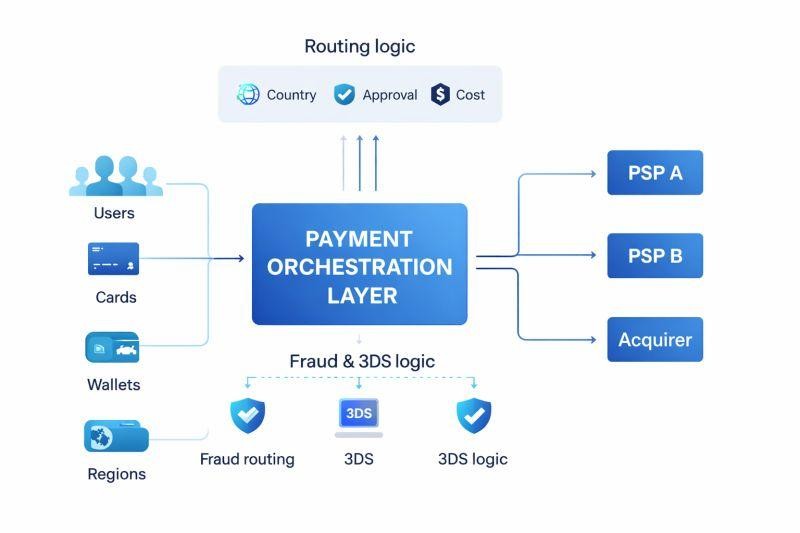
Payment Orchestration Architecture
The architecture generally follows this flow:
Commerce Frontend
Customer InterfaceCheckout Service
Order ProcessingPayment Orchestration Layer
Centralized Routing & ControlPayment Providers
Payment ProcessingBanking Networks
Financial InstitutionsA connected payment ecosystem that simplifies communication between commerce applications and financial systems.
Payment orchestration combines several components to manage payment operations across different providers.
The orchestration layer manages provider communication and payment routing. It also handles provider-specific request formats, transaction responses, and payment status updates.
In a composable environment, this separation allows payment services to evolve independently without requiring major changes to the checkout application.
Payment Orchestration vs. Traditional Payment Integration
Traditional payment integration usually connects a commerce platform directly to one or more payment providers. Payment orchestration introduces a dedicated layer to coordinate these integrations.
Traditional Integration | Payment Orchestration |
Direct provider integration | Centralized orchestration layer |
Provider-specific logic | Unified payment interface |
Limited routing flexibility | Configurable routing rules |
Separate provider management | Centralized provider management |
Additional integrations may require development | New providers can often be added through existing orchestration capabilities |
Security Considerations in Payment Orchestration
Security is essential because payment orchestration handles sensitive transaction workflows. Businesses must protect payment information and ensure that all connected payment providers follow appropriate security requirements.
Secure Payment Ecosystem
Security at every stage of the payment journey.
Use Tokenization
Use tokenization to reduce exposure of sensitive card data.
DATA PROTECTIONFollow PCI DSS Requirements
Follow applicable PCI DSS requirements.
COMPLIANCEEncrypt Payment Information
Encrypt payment information during transmission.
ENCRYPTIONAPI Authentication & Authorization
Implement authentication and authorization for payment APIs.
ACCESS CONTROLValidate Webhooks
Validate payment notifications and webhook signatures.
REQUEST VALIDATIONMaintain Transaction Logs
Maintain transaction logs for auditing and investigation.
AUDIT & MONITORINGStrong payment security builds trust, protects sensitive information, and supports reliable transaction management.
Challenges in Implementing Payment Orchestration
Although payment orchestration improves payment flexibility, implementing it requires careful planning. Businesses must manage provider differences, transaction consistency, security requirements, and operational complexity.
Challenges in Implementing Payment Orchestration
Managing multiple payment providers introduces technical and operational complexities that require careful planning and coordination.
Overcoming Payment Complexity
A multi-provider payment ecosystem requires consistent integrations, transaction handling, and operational visibility.
API Integration Differences
Integrating providers with different API specifications.
INTEGRATION COMPLEXITYDuplicate Requests & Retries
Managing duplicate payment requests and retry scenarios.
TRANSACTION MANAGEMENTAsynchronous Notifications
Handling asynchronous payment notifications.
EVENT MANAGEMENTTransaction Status Consistency
Maintaining consistent transaction and order statuses.
STATUS MANAGEMENTMulti-Provider Reconciliation
Reconciling transactions across multiple providers.
FINANCIAL OPERATIONSFailure & Availability Monitoring
Monitoring payment failures and provider availability.
SYSTEM MONITORINGAddressing these challenges is essential for building a reliable and scalable payment orchestration ecosystem.
Best Practices for Implementing Payment Orchestration
Six essential practices to create a secure, reliable, and scalable payment orchestration ecosystem.
Use Standardized Payment Interfaces
Define consistent interfaces for communicating with different payment providers.
Unified CommunicationImplement Idempotency
Prevent duplicate transactions when payment requests are retried.
Duplicate PreventionConfigure Intelligent Routing
Define routing rules based on provider availability, supported regions, and transaction requirements.
Smart Provider SelectionSecure Payment Data
Use tokenization and secure payment handling practices.
Data ProtectionMonitor Transaction Performance
Track authorization rates, failures, latency, and provider availability.
Continuous MonitoringDesign for Failure Recovery
Handle timeouts, retries, and uncertain transaction outcomes safely.
Reliable OperationsMake Every Payment Count
Follow these best practices to build a flexible, secure, and resilient payment orchestration architecture.
Conclusion
Payment orchestration plays an important role in composable commerce by providing a centralized way to manage multiple payment providers and transaction workflows. It reduces direct dependencies between the commerce platform and payment services, allowing businesses to adapt their payment infrastructure as requirements change.
By implementing a well-designed payment orchestration layer, enterprises can improve payment flexibility, support global transactions, and build more resilient checkout experiences. This makes payment orchestration an important capability for businesses developing scalable composable commerce ecosystems.